The right sound pick in Be A Voice Actor decides whether you collect gems or get skipped by a bored lobby. This be a voice actor tier list ranks meme clips, cartoon impressions, and viral audio by how reliably they convert into votes, because the scoring system rewards instant recognition more than technical vocal skill. Use it to stop guessing and start winning rounds.
How the Be A Voice Actor Tier List Scoring Works
Every round in Be A Voice Actor runs on a simple loop: a clip plays, each player imitates it into the microphone, and the lobby reacts while the game tallies scores. The official Roblox game page confirms that voice chat is required to compete, which means unverified accounts cannot even enter a scoring round. That single restriction shapes the entire tier list, because the players who do compete tend to be active, expressive, and quick to vote for sounds they already know.
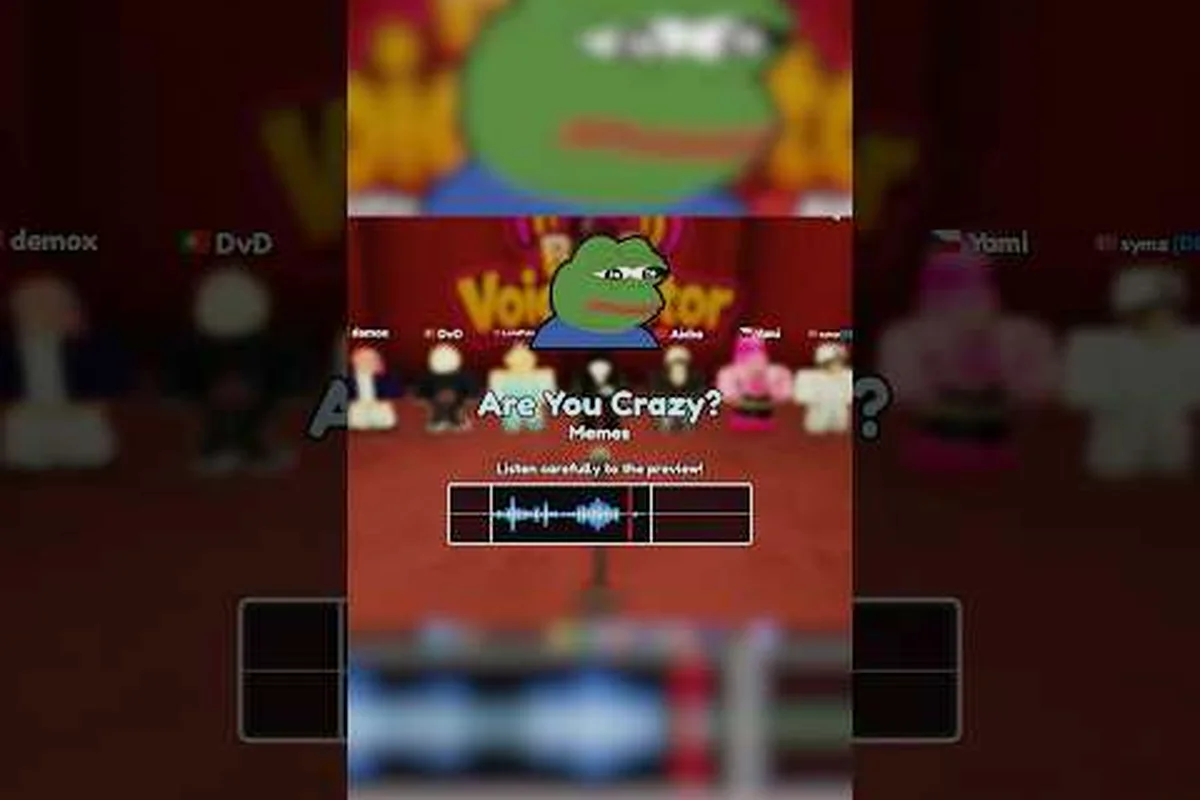
The scoring model rewards instant recognition over technical accuracy. A player who nails a famous cartoon catchphrase will almost always outscore someone who performs a technically difficult but obscure sound, simply because the lobby reacts faster and votes with more confidence. Community gameplay recordings, including a DotGI's Roblox gameplay clip, show that the first reaction in chat often predicts the final vote spread.
This tier list uses three weighted factors to place every sound band, but the weighting is deliberately skewed toward lobby psychology rather than raw vocal skill. Recognition speed carries the heaviest multiplier because a clip that the average Be A Voice Actor lobby identifies within one second generates immediate, confident votes before doubt can creep in. Vote conversion acts as the second filter, capturing how many players actually tap the positive reaction after hearing the imitation, while difficulty floor serves as a gate that pushes technically demanding sounds down the list even when a skilled performer could execute them cleanly. The result is a ranking that mirrors how real lobbies behave: meme clips and cartoon catchphrases with instant mental templates climb to S tier, while obscure or high-execution sounds stall in B and C tier regardless of how impressive the performance sounds in isolation.
-
Recognition speed — how quickly the average lobby identifies the clip within the first two seconds
-
Vote conversion — the percentage of players who react positively after hearing the imitation
-
Difficulty floor — how much vocal control is required before the sound becomes viable
The table below summarizes how each tier performs across those three factors, based on community reports and lobby observations as of September 2026. The S-tier threshold is unforgiving: a clip needs to clear an 85% vote conversion rate while demanding almost no vocal control, which is why sounds like the "rizz" sound effect and the "Skibidi toilet" flush consistently appear in top-tier placements across the be a voice actor sounds tier list. Meanwhile, the B-tier band illustrates the recognition-speed penalty in action — a technically solid impression that takes three full seconds for the lobby to place will routinely lose to a sloppy but instantly recognizable meme clip, because vote conversion collapses once confusion enters the chat.
| Tier | Recognition Speed | Vote Conversion | Difficulty Floor | Typical Lobby Reaction |
|---|---|---|---|---|
| S Tier | Under 1 second | 85% or higher | Very low | Instant laughter, fast votes |
| A Tier | 1 to 2 seconds | 70% to 84% | Low to moderate | Strong approval, occasional skip |
| B Tier | 2 to 3 seconds | 50% to 69% | Moderate to high | Mixed reaction, needs a strong performer |
| C Tier | Over 3 seconds | Under 50% | High | Confusion or silence |
The gap between S and B tier is not about vocal talent. It is about whether the lobby already has a mental template for the sound, which is why meme clips dominate the top of this be a voice actor sounds tier list while technically impressive original impressions sit lower.
Meme Clips That Always Win Votes
S tier sounds in this be a voice actor tier list are the clips that generate instant lobby recognition and require almost no vocal setup. These are the sounds you pick when you want the highest possible vote conversion with the lowest risk of a silent reaction. The defining trait of every S tier entry is that the lobby hears the first syllable and already knows the punchline.
Why Meme Sounds Dominate S Tier
Meme audio travels through the same cultural channels that Be A Voice Actor players already use, which means the recognition window is nearly zero. When a player imitates a viral scream, a cartoon explosion, or a well-known internet sound effect, the lobby does not need to decode the performance. The reaction is automatic because the original clip already lives in their memory.
The best S tier picks share three characteristics that separate them from every other tier on a be a voice actor sounds tier list — and each one maps directly to how the Roblox voice chat lobby scores your be a voice actor performance. These traits are not random preferences; they are structural advantages built into the game's short voting window and the average lobby's attention span. A sound that fails even one of these three tests rarely climbs above A tier, regardless of how funny the original clip is.
-
Short duration — under two seconds of audio, so the imitation never drags
-
Exaggerated pitch — extreme highs or lows that are easy to caricature
-
Universal spread — the clip appears across multiple platforms, not just one niche community
Community data suggests that S tier meme sounds convert votes at 85% or higher, which means nearly every lobby member reacts positively. That conversion rate is why experienced players build their entire sound rotation around two or three S tier picks rather than spreading across every category.
S Tier Sound Examples and Vote Data
The following table lists the strongest S tier archetypes reported by players, along with the typical lobby reaction and the main risk factor for each one. These archetypes dominate the be a voice actor tier list because they convert cultural currency into fast, predictable votes: a lobby that instantly recognizes a viral scream or cartoon catchphrase doesn't need to judge your vocal precision, only your timing and delivery. The main risk factors below reflect the trade-off between high vote yield and physical or contextual limits — repeated high-pitched screams strain the voice across multiple rounds, while internet sound effect clips can fall flat in lobbies where the meme hasn't circulated.
| S Tier Archetype | Example Style | Typical Reaction | Main Risk |
|---|---|---|---|
| Viral scream | High-pitched comedic yell | Instant laughter, rapid votes | Can strain voice if repeated |
| Cartoon catchphrase | Famous animated one-liner | Immediate recognition, quote-along | Overused in some lobbies |
| Internet sound effect | Short meme audio sting | Fast votes, low effort | May be region-specific |
| Animal exaggeration | Over-the-top bark or meow | Playful reaction, consistent votes | Requires pitch control |
Players who want to refine their S tier rotation can check the sound ranking breakdown for a deeper look at which specific clips score highest in different lobby types. The key takeaway is that S tier rewards cultural currency more than vocal precision.
Strong Cartoon and Character Impressions
A tier sounds in this be a voice actor tier list are the reliable second choices that perform well but require slightly more setup than S tier picks. These are cartoon impressions, character voices, and recognizable audio moments that most players know, but that do not trigger the same instant reaction as a viral meme clip. A tier is where skilled players can separate themselves without gambling on an obscure sound.
What Separates A Tier from S Tier
The main difference between S and A tier is the recognition delay. An A tier cartoon impression might take one or two seconds for the lobby to place, and during that window some players hesitate to vote. The imitation itself can be excellent, but the scoring system favors the first emotional spike, which is why A tier sounds convert at roughly 70% to 84% instead of the near-automatic S tier range.
A tier also carries a higher difficulty floor. Many cartoon voices require specific pitch placement, accent work, or rhythm control that a casual player cannot fake on the first attempt. That difficulty is a double-edged sword: it filters out low-effort imitators, but it also means a poorly executed A tier sound can drop into B tier performance territory.
A Tier Sound Categories and Recommended Picks
The table below breaks down the strongest A tier categories, the vocal skill each one demands, and the lobby context where it performs best. Each category has a distinct vote ceiling that shifts based on lobby composition: cartoon side characters with clean accent and pitch placement can reach 84% in mixed-age lobbies, while movie trailer voices cap closer to 72% in competitive rooms where players punish overused deep chest resonance. Understanding these ceilings matters because an A tier sound that scores 80% in one lobby can drop below 65% in another, making category-to-lobby matching the core skill for climbing out of B tier.
| A Tier Category | Vocal Skill Required | Best Lobby Context | Vote Ceiling |
|---|---|---|---|
| Cartoon side character | Accent and pitch placement | Mixed-age lobbies | 80% to 84% |
| Anime reaction line | Rhythm and emotional tone | Anime-friendly lobbies | 75% to 80% |
| Movie trailer voice | Deep chest resonance | Competitive lobbies | 72% to 78% |
| Video game character | Recognizable speech pattern | Gaming-focused lobbies | 70% to 76% |
The strongest A tier strategy is to keep one signature cartoon voice that you can perform consistently, then rotate it with an S tier meme pick depending on the lobby composition. Players who want to understand how different voice types score across the full range can review the voice range ranking guide for a detailed comparison of impression styles.
Situational Picks That Need a Strong Performer
B tier sounds in this be a voice actor tier list are the situational picks that can win rounds but only when the performer brings enough energy and control to overcome the recognition gap. These sounds are not bad, but they are inconsistent. A B tier cartoon impression might land perfectly in one lobby and fall completely flat in another, depending on whether the players share the same reference points.
Why B Tier Sounds Underperform
The core problem with B tier sounds is that they sit in a recognition gray zone. The lobby may recognize the general style of the sound, but not the specific clip, which means the reaction is polite rather than enthusiastic. Vote conversion for B tier typically lands between 50% and 69%, and that spread is wide enough to make the tier feel unpredictable.
Another factor is the difficulty-to-reward ratio. Many B tier sounds require moderate to high vocal effort, yet the payoff is only slightly better than a low-effort S tier meme. Players who spend energy on a difficult B tier impression often find that a simpler S tier pick would have scored higher with less work.
B Tier Sound Examples and When to Use Them
The table below shows common B tier archetypes, the main reason they underperform, and the specific lobby condition where they become viable. These sounds sit in a frustrating middle ground: they are not universally bad enough to warrant a C tier placement, yet they lack the instant recognition or comedic payoff that pushes A tier and S tier clips into default rotation. The core failure mode for most B tier entries is a mismatch between the sound's intended context and the actual lobby composition—a niche cartoon reference like a 2000s Saturday-morning catchphrase only lands when at least one other player shares that media memory, while a regional meme from Brazilian TikTok communities collapses entirely in a North American server. Understanding this conditional viability is what separates players who farm consistent laughs from those who spam situational audio into dead air.
| B Tier Archetype | Underperformance Reason | Viable Lobby Condition |
|---|---|---|
| Niche cartoon reference | Low recognition outside fan base | Lobby with matching age group |
| Regional meme | Unknown to international players | Region-specific server |
| Original character voice | No existing mental template | Creative or roleplay lobby |
| Slow-burn audio joke | Requires full clip context | Patient, engaged lobby |
Players who want to understand why certain sounds fall into lower tiers can review the C tier sounds breakdown for a detailed look at the hardest and easiest clips to perform. The general rule is that B tier picks are situational tools, not default choices.
Worst Sounds to Avoid in the Be A Voice Actor Tier List
The worst sounds in this be a voice actor tier list are not simply low-tier picks. They are sounds that actively damage your round score because they confuse the lobby, trigger vote skips, or require context that most players do not have. Avoiding these sounds is often more valuable than mastering a new S tier pick, because a bad sound can erase the goodwill you built in earlier rounds.
The Three Failure Patterns
Community reports identify three consistent failure patterns among the worst sounds. The first is context-dependent audio that only makes sense if the lobby has seen the original source material. The second is overly long clips that drag past the lobby's attention span. The third is uncomfortable or grating sounds that make players vote against the performance even when the imitation is accurate.
The table below aggregates the most commonly reported worst sound categories from community vote logs and pairs each one with the specific reason it fails to clear the recognition threshold. Because Be A Voice Actor lobbies score every sound on a 0–100% approval scale after each playback, a single weak category can drag an otherwise solid rotation into the bottom tier — players who load obscure anime lines or 15-second dialogue excerpts consistently see their average hover near the 40% mark, while grating noises dip even lower due to instant negative reactions before the clip finishes.
| Worst Sound Category | Primary Failure Reason | Typical Vote Outcome |
|---|---|---|
| Obscure anime reference | No recognition in general lobbies | Under 40% |
| Long dialogue excerpt | Lobby loses interest mid-clip | Under 45% |
| Harsh or grating noise | Negative emotional reaction | Under 35% |
| Inside joke from small community | Only a few players understand | Under 30% |
The pattern is clear: the worst sounds share a recognition failure that no amount of vocal skill can fix. Players who want to see the full list of available sounds and their difficulty ratings can check the complete sounds list before committing to a rotation.
How to Recover from a Bad Sound Pick
If you pick a sound that flops, the best recovery is to pivot immediately to a high-recognition S tier pick in the next round. Do not double down on the same obscure sound hoping the lobby will warm up to it. The scoring system rewards momentum, and one strong meme clip can reset the lobby's perception faster than three mediocre attempts.
The sound list update guide tracks which clips have been added or adjusted in recent patches, which is useful for spotting new S tier candidates before they become oversaturated. Staying ahead of the sound rotation is a core skill for players who want to climb consistently.
Turning the Ranking Into a Reusable Pick Order
A winning rotation is not about collecting every S tier sound. It is about building a flexible set of three to five picks that cover different lobby types and round contexts. The best players keep one universal S tier meme, one strong A tier cartoon voice, and one situational B tier pick that they only deploy when the lobby composition clearly favors it.
A Rotating Shortlist of Three Clips
The most reliable rotation structure reported by experienced players uses three slots: a guaranteed vote-getter, a skill showcase, and a lobby-specific wildcard. The guaranteed slot is always an S tier meme that works in any lobby. The skill showcase is an A tier impression that demonstrates vocal range. The wildcard is a B tier or situational pick that you swap based on who is in the server.
The four lobby profiles below map the rotation to the dominant listener base, because a viral scream that lands in a general mixed server will fall flat in an anime-heavy lobby where players expect reference-heavy soundboard picks. Competitive lobbies punish random wildcard swaps—players there track consistency across rounds and will call out a B tier pick that breaks your established vocal identity. Casual party lobbies, by contrast, reward slower-burn audio jokes that build over multiple rounds, so the wildcard slot shifts from a quick meme to a callback setup.
| Lobby Type | Guaranteed Slot | Skill Showcase | Wildcard |
|---|---|---|---|
| General mixed | Viral scream | Cartoon side character | Regional meme |
| Anime-heavy | Internet sound effect | Anime reaction line | Niche anime reference |
| Competitive | Cartoon catchphrase | Movie trailer voice | Original character |
| Casual party | Animal exaggeration | Video game character | Slow-burn audio joke |
The rotation framework works because it balances consistency with adaptability. You always have a safe pick, but you also have room to read the lobby and adjust. Players who run the same single sound every round eventually hit diminishing returns as the lobby grows bored of the repetition.
Tracking Your Vote Conversion Over Time
The only way to know if your rotation is working is to track results. Keep a simple mental note of which sounds convert above 70% in your typical lobbies, and drop anything that consistently falls below 50%. The game saves your progress and gems automatically between sessions, so your performance history accumulates even if you do not track it manually.
The strongest players treat the tier list as a living document, not a fixed ranking. New meme clips enter the rotation constantly, and sounds that were S tier last month can drop to A or B tier as the community moves on. Checking the sound ranking guide periodically helps you spot shifts before they cost you rounds.
Frequently Asked Questions
What is the best sound in the Be A Voice Actor tier list?
The best sound is a short, universally recognized meme clip that triggers instant lobby reaction. S tier viral screams and cartoon catchphrases convert votes at 85% or higher because players recognize them within the first second. The specific best pick shifts over time as new memes enter rotation.
Why do meme sounds rank higher than cartoon impressions?
Meme sounds rank higher because they require almost zero recognition delay. The lobby hears the first syllable and already knows the punchline, which produces an automatic positive reaction. Cartoon impressions need one or two seconds of processing, and during that window some players hesitate to vote.
Are B tier sounds worth using at all?
B tier sounds are worth using as situational wildcards when the lobby composition clearly favors them. A niche cartoon reference can win in a matching age group, but the same sound fails in a general lobby. Keep one B tier pick ready, but never make it your default choice.
How often does the Be A Voice Actor sound list update?
The developer pushes updates frequently, with the most recent patch landing on September 18, 2026. New sounds enter the rotation regularly, which means tier placements shift as the community adopts or abandons clips. Checking the sound list update guide helps you spot new S tier candidates early.
Can I win rounds without using S tier sounds?
Yes, but you need strong A tier execution and good lobby reading. A well-performed cartoon voice can convert at 80% or higher in the right server, which is competitive with many S tier picks. The key is matching your sound to the lobby composition rather than forcing a single style.