Most players walk into their first Be A Voice Actor lobby, hear a random clip, and freeze because they never practiced reading the room before opening their mouth. These be a voice actor beginner tips fix that by turning lobby observation into a repeatable skill, so you stop losing votes to players who simply sound more prepared than you feel.
What Makes a Lobby Readable Before Your First Round
The official Roblox listing for Be A Voice Actor confirms that voice chat is required to compete, which means every player in your 7-person server has already passed platform voice verification and is ready to talk. That detail matters more than it seems because it tells you the lobby is not full of silent observers. Everyone is a potential competitor, and the sounds they choose to imitate reveal how they think about the game.
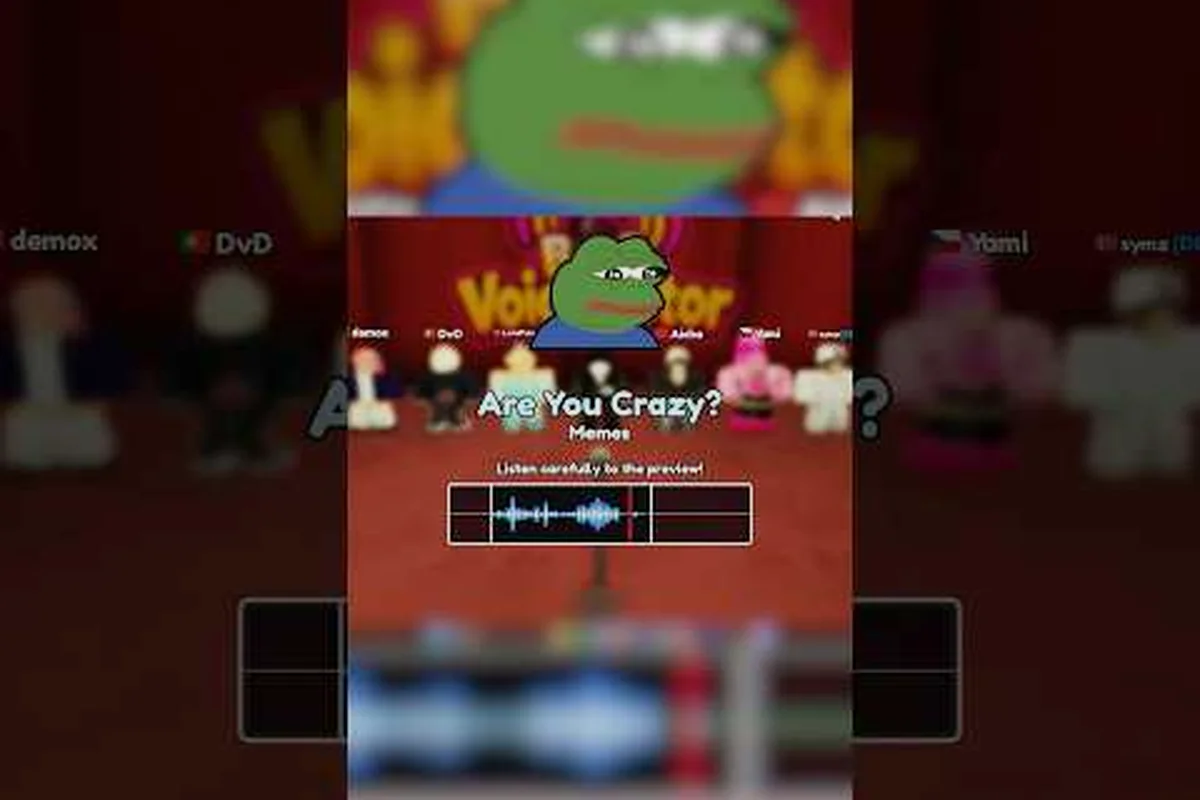
Community gameplay footage from the Enki Army upload shows the stage layout clearly: a row of players lined up on a red stage with a microphone prop in the center, clip playback happening round by round, and a scoreboard appearing at the end of each session. Watching that layout before your first match helps you understand where attention goes. The microphone is the focal point, so players who step toward it confidently tend to read as more experienced even before they make a sound.
Reading a lobby starts with three observable signals. First, watch how many players warm up by humming or testing their microphone before the clip plays. Second, notice who stays silent until the exact moment the scoring window opens. Third, pay attention to which players react to other people's performances with quick laughter or visible surprise, because those reactions often reveal what the lobby considers impressive.
| Lobby Signal | What It Tells You | How to Respond |
|---|---|---|
| Player tests mic before round | They care about audio clarity | Match their energy, check your own input level |
| Player stays silent until scoring | They treat each clip as a performance | Avoid filler noise, wait for the clip |
| Player laughs at a specific imitation | That sound type gets positive feedback | Note the sound category and prepare a variant |
| Player leaves after one bad round | Lobby pressure feels high | Stay calm, focus on your next clip |
| Player repeats the same sound twice | They found a comfort zone | Do not copy them, pick a contrasting sound |
The official Be A Voice Actor game page lists the core loop as imitating popular sounds to gain the highest score, which means the lobby is always evaluating you against a scoring system rather than pure social approval. Understanding that distinction prevents you from chasing laughs when the algorithm rewards accuracy.
How Scoring Pressure Changes the Way You Read a Lobby
Be A Voice Actor uses a scoring system that compares your microphone input to the reference clip, and the pressure of that comparison changes how players behave between rounds. When you understand how scoring works in this game, you start noticing that confident players rarely waste energy on sounds they cannot control. They pick clips that match their vocal range, and they commit fully instead of hedging with a quiet, uncertain attempt.
The game reached 1,537,018 total visits with 29,540 favorites and a 98.3% approval rating as of September 18, 2026, according to the live stats snapshot on the Roblox page. Those numbers tell you that the player base is active and generally positive, which lowers the social risk of sounding silly. A lobby full of approving players is a lobby where bold choices get rewarded more often than timid ones.
| Scoring Behavior | Lobby Read | Best Counter |
|---|---|---|
| Player goes silent after a low score | They are recalibrating | Give them space, do not mock |
| Player immediately queues another round | They treat losses as data | Adopt the same rapid iteration mindset |
| Player narrates their own attempt | They are managing expectations | Stay focused on your own clip |
| Player celebrates a mid score | They value participation | Match positivity without overacting |
| Player asks what the clip was | They missed the reference | Replay the clip mentally before your turn |
A separate breakdown of how scoring works in Be A Voice Actor is available in the scoring system guide, which explains why accuracy matters more than volume. Reading the lobby becomes easier once you know that a loud, confident wrong sound scores lower than a quiet, accurate one, because you can spot which players understand that rule and which ones are still performing for the audience.
Why the 7-Player Cap Makes Every Lobby Feel Different
The hard 7-player server cap means you never face a huge anonymous crowd. Every lobby is small enough that individual personalities dominate the atmosphere, and that intimacy is exactly why reading the room matters so much. One aggressive player can shift the whole energy, while one supportive player can make everyone else relax.
Because the maximum server size is only 7 players, you will see repeat faces if you play multiple sessions in a row. That repetition builds a micro-community where reputation forms quickly. Players remember who nailed a difficult sound and who panicked, so your first game in any given lobby sets the tone for how others treat you in later rounds.
Be A Voice Actor Getting Started: Your First Game Checklist
Getting started in Be A Voice Actor feels chaotic if you treat your first game as a pure performance test. A better approach is to treat it as a data-gathering session where you learn the clip library, the scoring rhythm, and the lobby's social temperature all at once. The players who improve fastest are the ones who walk into their first game with a simple checklist instead of a desperate need to win.
Your first game checklist should include five actions. First, verify your microphone input level before joining a scoring round, because a clipped or too-quiet signal wastes every clip regardless of your talent. Second, listen to at least two full rounds before your first attempt so you understand the clip length and the scoring window. Third, pick a sound category you can physically produce without straining, even if it is not the most impressive option. Fourth, commit to your imitation fully instead of trailing off halfway through. Fifth, review your score after the round and note whether the game rewarded accuracy, timing, or volume.
| First Game Step | Why It Matters | Common Mistake |
|---|---|---|
| Check mic input level | Prevents technical failure | Assuming Roblox auto-adjusts perfectly |
| Observe two rounds first | Builds clip library context | Jumping in blind on round one |
| Pick a comfortable sound | Maximizes accuracy | Choosing the hardest clip to show off |
| Commit fully to the imitation | Signals confidence to scoring | Trailing off when unsure |
| Review score after round | Creates a feedback loop | Ignoring the number and repeating errors |
The developer group behind Be A Voice Actor, Frameworks, has around 9,000 members and uses the group wall as the main update channel, according to the official group page. Joining that group gives you early patch information and a the group membership badge, which is useful when you are getting started because update notes often explain scoring tweaks before the community fully understands them.
How to Practice Without Burning Your First Impression
You do not need to enter a live lobby to practice the core skill of listening and reproducing sounds. Record yourself imitating common sounds like a door creak, a dog bark, or a cartoon laugh, then play the recording back and compare it to the original. That loop builds the exact skill the game scores, and you can do it privately before your first match.
Community players report that the fastest improvement comes from practicing sound categories you normally avoid. If you always do animal sounds, spend a session on mechanical noises. If you lean on silly voices, try clean, neutral tones. Expanding your range before your first game means you will not panic when the clip library throws you something unexpected.
Be A Voice Actor How to Get Better: Reading the Room Mid-Match
Getting better at Be A Voice Actor requires you to read the room not just before the match, but during every single round. The lobby's energy shifts after each score reveal, and players who notice those shifts can adjust their strategy in real time. A player who bombs a round might become more conservative, while a player who scores high might get overconfident and sloppy.
Mid-match reading works best when you track three variables. First, track which sound categories keep appearing, because the clip rotation is short and patterns emerge quickly. Second, track which players are gaining or losing confidence based on their body language and voice tone. Third, track your own energy level, because fatigue makes your imitations flatter and less accurate as the session continues.
| Mid-Match Variable | How to Track It | Adjustment to Make |
|---|---|---|
| Repeating sound categories | Note each clip type mentally | Prepare a variant for the next repeat |
| Player confidence shifts | Watch posture and voice energy | Exploit overconfidence with consistency |
| Your own fatigue | Notice when imitations get flat | Take a one-round mental reset |
| Lobby mood after scores | Listen for laughter or silence | Match the mood without losing focus |
| Clip difficulty spikes | Flag unusually hard sounds | Save energy for the next easy clip |
The closest competitor in the same Roblox sub-genre, Make That Sound!, launched on August 31, 2026, and has accumulated about 3.4 million visits with roughly 22,000 favorites. Be A Voice Actor counters with a shorter round rotation and a faster update cadence, which means the clip library changes more often than you might expect. Players who assume the clips stay static will get surprised mid-match, while players who expect variety can adapt faster.
The Confidence Loop That Separates Good From Great
The difference between a good voice actor and a great one in this game is not raw vocal talent. It is the confidence loop that forms when you read the room correctly, make a bold choice, get positive feedback, and use that feedback to make an even bolder choice next round. Players who break that loop by getting discouraged after one bad score never build the momentum that carries them through a full session.
Because the game saves progress, gems, and scores automatically between sessions, you never lose your accumulated data when you leave a lobby. That persistence means every match, even a bad one, contributes to your long-term understanding of the clip library and scoring patterns. Treating each session as a permanent data point removes the pressure to perform perfectly every single round.
Advanced Lobby Reading for Longer Sessions
Once you have played several matches, you can start reading lobbies at a deeper level by watching how players manage their energy across a full session. The first round usually features everyone at peak enthusiasm, but by round five or six, the players who paced themselves are still sharp while the ones who went all-out early are fading. That fatigue differential creates openings for consistent players to climb the scoreboard late in the session.
Advanced lobby reading also involves recognizing the difference between players who are naturally funny and players who are naturally accurate. The scoring system rewards accuracy, but the social layer rewards humor, and the best players find a way to deliver both. A player who can make the lobby laugh while still matching the reference clip closely will dominate the scoreboard and the social dynamic simultaneously.
| Player Type | Lobby Behavior | How to Beat Them |
|---|---|---|
| Natural comedian | Prioritizes laughs over accuracy | Out-score them with clean accuracy |
| Technical perfectionist | Nails every clip but stays quiet | Match their accuracy, add warmth |
| Energy bomb | Peaks early, fades late | Conserve energy, dominate late rounds |
| Silent sniper | Says little, scores high | Do not underestimate them, stay consistent |
| Social butterfly | Talks constantly, scores mid | Let them talk, focus on your own clips |
The beginner guide for Be A Voice Actor covers the fundamental mechanics of how to play and win, which pairs well with the lobby-reading skills covered here. Once you understand both the mechanical scoring and the social dynamics, you can start experimenting with advanced strategies that combine accurate imitation with smart lobby positioning.
When to Stop Reading and Start Performing
There is a point in every lobby where reading the room turns into overthinking, and that point usually arrives after you have gathered enough information to make a confident choice. If you spend three rounds observing without ever performing, you lose the chance to build your own reputation and gather personal scoring data. The best players observe for one or two rounds, then jump in and start iterating.
The game's shorter round rotation compared to its competitor means you do not have time to over-analyze every clip. By the time you have fully dissected a sound, the next one is already playing. Learning to make fast, confident decisions based on partial information is a skill that transfers directly to better scores, because hesitation shows up in your voice and drags down your accuracy.
Frequently Asked Questions
What are the best be a voice actor beginner tips for a first game?
Focus on microphone clarity, observe two rounds before performing, and pick a sound you can produce without strain. Commit fully to each imitation instead of trailing off, and review your score after every round to build a feedback loop. These habits prevent the panic that costs new players votes.
Do I need voice chat verified before playing Be A Voice Actor?
Yes, the official Roblox listing states that voice chat is required to compete, so you must complete platform voice verification before joining a scoring round. Without verification, you cannot take part in the core gameplay loop, which means setting up voice chat is the first step in getting started.
How does reading the lobby help me get better at Be A Voice Actor?
Reading the lobby reveals which sound categories get positive reactions, which players understand the scoring system, and when the room's energy shifts after each score reveal. That information lets you adjust your strategy in real time, pick sounds that match the lobby's mood, and avoid choices that will cost you votes.
Is Be A Voice Actor similar to Make That Sound?
Both games use the same core loop of listening to a clip, copying it into your microphone, and getting scored. Be A Voice Actor differentiates itself with a hard 7-player server cap, a shorter round rotation, and a faster update cadence, which creates a more intimate and dynamic lobby experience.
Can I practice Be A Voice Actor without joining a live lobby?
Yes, record yourself imitating common sounds like door creaks, animal noises, and cartoon laughs, then compare your recordings to the originals. That private practice loop builds the exact listening and reproduction skills the game scores, so you can enter your first lobby with more confidence and a wider vocal range.