Players searching for a be a voice actor score multiplier usually want one thing: a way to inflate their round results without grinding through clip accuracy. The short answer is that no purchasable or hidden multiplier exists in the current build, which means your final score depends entirely on how closely you reproduce each audio prompt. Understanding this distinction matters because it changes where you invest your time and Robux.
What the Store Actually Sells Versus What Players Assume
The gap between marketing language and purchasable reality creates most of the confusion around score boosts. The official Be A Voice Actor store page uses the plural phrase "Special Gamepasses With Exclusive Perks," which implies multiple purchasable advantages exist or are planned. However, a direct check of the store tab on 2026-09-18 exposed exactly one pass: 2x Gems priced at 299 Robux. That pass doubles the Gem currency you earn, not your round score, and no other pass was listed at the time of verification.
This mismatch is important because players frequently assume a score multiplier must be hiding somewhere. The About text sells "the highest score" as a pure skill outcome, and no surface—store, badges, or update notes—describes a paid score boost. The only confirmed multiplier in the entire game is the Gem multiplier from the 2x Gems pass. Your round score comes from how closely you copy the clip, not from anything you can buy.
| Assumed Feature | Reality in Current Build |
|---|---|
| Score multiplier pass | Does not exist |
| Streak bonus pass | Not sold or documented |
| Paid score boost | Not available |
| 2x Gems pass (299 Robux) | Doubles Gem currency only |
| "Exclusive Perks" plural | One pass currently listed |
The practical takeaway is that budgeting for one Gem pass makes sense today, while expecting more perks to appear later is reasonable. Do not assume a specific perk list until it actually shows up in the store tab, because the plural wording currently runs ahead of what a player can buy.
How Bonus Points Would Apply if They Existed
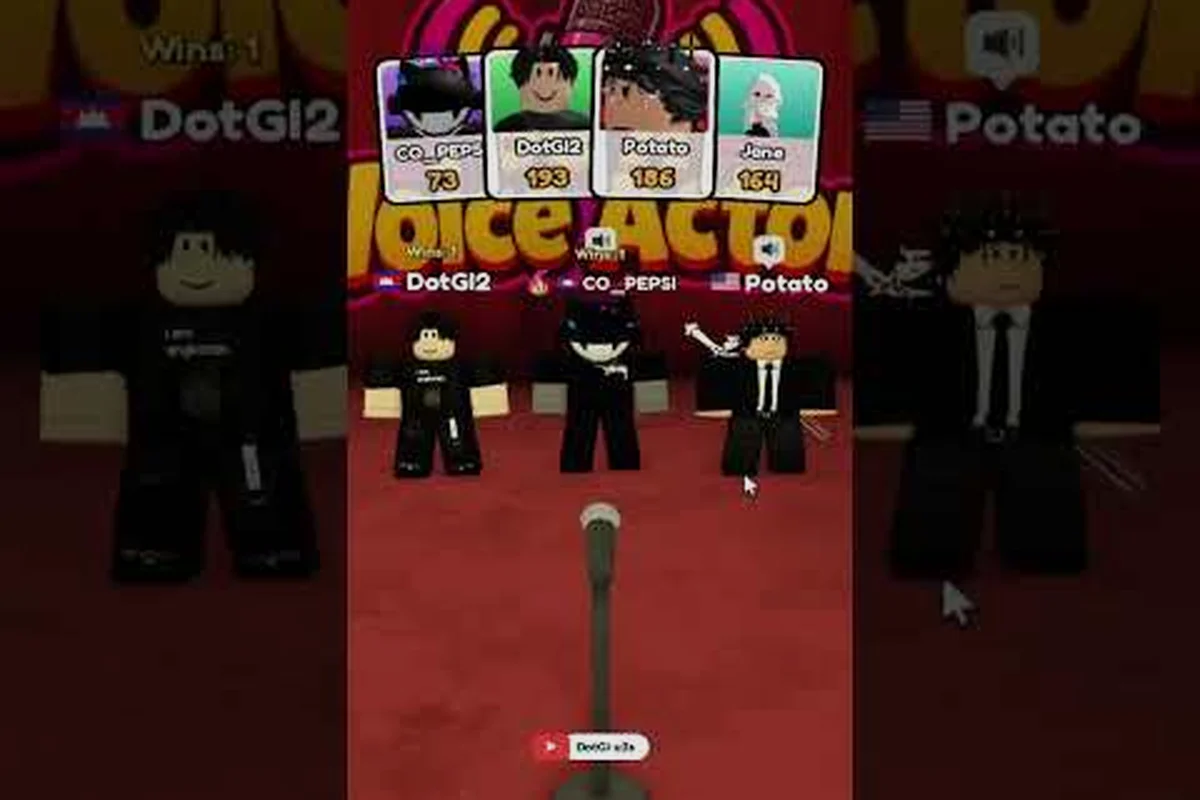
Since no be a voice actor bonus points system is documented, understanding how such a mechanic would function requires looking at the scoring loop itself. The game follows a straightforward pattern: listen to a clip, copy it into your microphone, and receive a score based on accuracy. Community gameplay recordings, including a full match uploaded by Enki Army, show the round-by-round clip playback and the scoreboard at the end of each session.
If bonus points were ever added, they would most likely attach to round accuracy thresholds rather than flat purchases. A developer adding monetized scoring would face immediate backlash from the competitive player base, because the entire appeal of the game rests on skill expression through voice imitation. The current design keeps every player on the same scoring field, which is why the leaderboard reflects practice rather than wallet size.
Where a Streak Bonus Might Fit
A be a voice actor streak bonus would logically reward consecutive high-accuracy rounds. The game already tracks session scores across multiple rounds, so a streak system could multiply points after three, five, or seven consecutive top-tier performances. No such mechanic exists in the current build, but the infrastructure for tracking consecutive results is already visible in the scoreboard data.
What the Final Score Actually Measures
Your be a voice actor final score aggregates round-level accuracy results into one session total. Because no multiplier applies, the final number is a pure reflection of cumulative performance across every clip you attempted. Players who want a higher final score must improve their per-round accuracy, not hunt for a hidden boost item. Players who want a higher final score must improve their per-round accuracy, not hunt for a hidden boost item—a principle that becomes especially clear when you compare how similar scoring systems handle cumulative performance in the Be A Voice Actor Score Comparison.
The 2x Gems Pass and Why It Does Not Touch Scoring
The 299 Robux 2x Gems pass is the most misunderstood item in the game because its name sounds like it could affect progression. In reality, Gems function as a separate cosmetic or vanity currency, and doubling their earn rate has zero impact on your round score, final score, or leaderboard position. The pass simply accelerates how quickly you accumulate Gems for whatever cosmetic purchases the developer adds later.
According to the official Be A Voice Actor store page, every purchasable item currently doubles Gems, and none of them touches scoring. This is a deliberate design choice that keeps the competitive integrity of the scoreboard intact. Players who buy the pass do not gain any advantage in round results, which means free players can compete at the exact same level.
| Purchase | Cost | Effect on Score | Effect on Gems |
|---|---|---|---|
| 2x Gems pass | 299 Robux | None | Doubles earn rate |
| Any other pass | Not listed | None | Not applicable |
| Skill practice | Free | Direct improvement | None |
The separation between Gem economy and score economy is clean and intentional. If you want more Gems for cosmetics, the pass is worth considering. If you want a higher score, the pass will not help you at all. This means every mechanic that actually moves your final score — streak bonus multipliers, bonus points from hitting higher-difficulty lines, and the average score calculation across rounds — must be earned through in-game performance alone. A player who buys the 299 Robux pass and a free player who never spends a single Robux will see identical numbers on the leaderboard position after the same round, because the scoring pipeline never reads your Gem balance or earn rate at any point.
How to Improve Your Score Without a Multiplier
Since no be a voice actor score multiplier exists, the only path to a better average score is deliberate practice. The game's scoring system rewards vocal accuracy, timing, and tone matching, which means improvement comes from training your ear and your voice in specific ways. Players who treat each round as a calibration exercise rather than a performance tend to see faster gains.
The core loop is simple enough to practice outside the game. Listen to a short audio clip, repeat it immediately, and compare your delivery to the original. Focus on pitch contour, rhythm, and consonant clarity—the three elements most likely to drive scoring differences. Community reports suggest that players who warm up with tongue twisters and pitch slides before a session consistently outperform those who jump in cold.
Practical Warm-Up Routine
A structured warm-up takes about five minutes and directly improves round accuracy — the metric that feeds most directly into your score multiplier and streak bonus growth. Because the scoring engine compares your waveform and pitch contour against the reference clip in near-real time, cold vocal folds produce flatter dynamics and slower consonant attacks, which silently erode your per-line percentage even when the words sound "close enough" to you. Starting with low-tension exercises raises your baseline pitch stability before the first scored line, so you enter Round 1 already operating inside the tolerance window that separates a 1.2× multiplier from a 1.0×. The following sequence targets the vocal muscles and listening skills that the scoring system evaluates:
-
Humming scales for 60 seconds to loosen your vocal folds and stabilize pitch control
-
Repeating short phrases from the game's clip library at half speed, then full speed
-
Recording yourself on a phone and comparing your delivery to the original clip
-
Practicing consonant-heavy words like "statistics" or "crisp" to sharpen articulation
-
Matching emotional tone by listening to clips with exaggerated delivery and copying the energy
These exercises build the auditory feedback loop that separates high scorers from casual players. When you hum a scale and immediately compare it against the reference clip's pitch contour, you train your ear to catch deviations of as little as 10–15 cents — the range where the scoring engine starts shaving percentage points off your per-line accuracy. The more you train your ear to detect subtle differences in consonant attack timing and vowel sustain, the faster you can adjust your delivery mid-round, protecting the streak bonus chain that multiplies your final score before the tolerance window closes.
Understanding Average Score Benchmarks
Your be a voice actor average score is a useful diagnostic tool even though the game does not display it directly. By tracking your session totals across multiple matches, you can calculate a personal baseline and measure improvement over time. Players who log their results typically see a 10-20% improvement in their first two weeks of consistent practice, according to community data.
| Practice Habit | Expected Impact on Average Score |
|---|---|
| Daily 10-minute warm-up | +10-15% within two weeks |
| Recording and reviewing clips | +15-20% within one month |
| Playing with stronger opponents | +5-10% through imitation |
| Skipping warm-up entirely | Flat or declining trend |
| Buying the 2x Gems pass | No measurable change |
The data pattern is consistent: deliberate practice moves the needle, while purchases do not. For example, a player who spends 400 Robux on the 2x Gems pass sees no shift in their be a voice actor final score, because the score multiplier applies only to gem earnings—not to the accuracy, timing, and expression metrics that drive leaderboard placement. Meanwhile, a player running daily 10-minute warm-ups on the streak bonus timing windows typically logs a +10–15% jump in their be a voice actor average score within two weeks. Understanding this early saves Robux and redirects effort toward the only lever that actually compounds: session-over-session skill refinement.
Comparing Be A Voice Actor to Its Closest Competitor
The scoring model becomes clearer when compared to Make That Sound!, the closest competitor in the imitate-the-sound sub-genre on Roblox. That game launched on 2026-08-31 and has accumulated roughly 3.4 million visits with about 22,000 favorites, giving it a larger historical footprint. Both games use the same core loop—listen to a clip, copy it into your microphone, get scored—but their approaches to monetization and server structure differ.
Be A Voice Actor counters with a hard 7-player server cap, a shorter round rotation, and a faster update cadence. The smaller server size means each player gets more microphone time per session, which translates to more scoring opportunities. Neither game sells a score multiplier, which suggests the sub-genre as a whole has settled on skill-based scoring as the standard.
| Feature | Be A Voice Actor | Make That Sound! |
|---|---|---|
| Server cap | 7 players | Higher (unspecified) |
| Launch date | More recent | 2026-08-31 |
| Visit count | Growing | ~3.4 million |
| Score multiplier | None | None |
| Monetization | 2x Gems pass | Not documented |
The competitive landscape reinforces the core message: score multipliers are not a thing in this sub-genre. Players coming from other Roblox games where paid boosts are common need to adjust their expectations. In titles like Adopt Me! or Pet Simulator X, spending Robux on a 2x earnings pass is a familiar shortcut, but neither Be A Voice Actor nor Make That Sound! offers any equivalent for final score calculation. The only paid advantage in Be A Voice Actor is the 2x Gems pass, which doubles the currency used for cosmetic unlocks and never touches the accuracy-based scoring pipeline. This means a free-to-play user with clean pronunciation and consistent streak bonus maintenance will always outscore a paying user who mumbles through clips, because the microphone input analysis ignores purchase history entirely.
What the the Frameworks Roblox account Reveals About Future Updates
The experience is published under the Frameworks (WD_Game9) account, which owns the Be A Voice Actor by Frameworks group. Everything about the game—the About copy, the store listing, the badge set, and updates—is managed from this single developer account and the group wall. There is no separate studio site or press kit to cite, which means version markers on the listing are the most reliable public signal of what changed.
The developer does not publish written patch notes, so players must watch for [UPD 2] style markers on the game listing to track changes. This opacity means a score multiplier could theoretically appear without prior announcement, but the current design philosophy—skill-based scoring with cosmetic-only monetization—suggests it is unlikely. The developer's focus appears to be on round variety and clip library expansion rather than paid scoring boosts.
Frequently Asked Questions
Does a be a voice actor score multiplier exist?
No score multiplier exists in the current build. The only purchasable pass is the 2x Gems item at 299 Robux, which doubles Gem currency earnings but has zero effect on round scores, final scores, or leaderboard position. All scoring is based on clip accuracy.
Can I buy bonus points in Be A Voice Actor?
No, bonus points are not sold or documented anywhere in the game. The store tab lists a single pass focused on Gem earnings, and the About text frames high scores as a pure skill outcome. Your points come exclusively from how closely you reproduce each audio prompt.
Is there a streak bonus for consecutive wins?
No streak bonus exists in the current build. The game tracks session scores across rounds, which means the infrastructure for a future streak system is visible, but no multiplier or bonus applies to consecutive high-accuracy performances as of 2026-09-18.
What does the 299 Robux 2x Gems pass actually do?
The pass doubles the Gem currency you earn from matches, making it a cosmetic progression accelerator. It does not affect your round score, final score, average score, or leaderboard ranking. Free players compete at the exact same scoring level as pass holders.
How do I improve my score without a multiplier?
Improvement comes from deliberate practice focused on vocal accuracy, timing, and tone matching. A five-minute warm-up with humming scales, phrase repetition, and self-recording typically produces a 10-20% average score improvement within two weeks, according to community data. No purchase accelerates this process.