
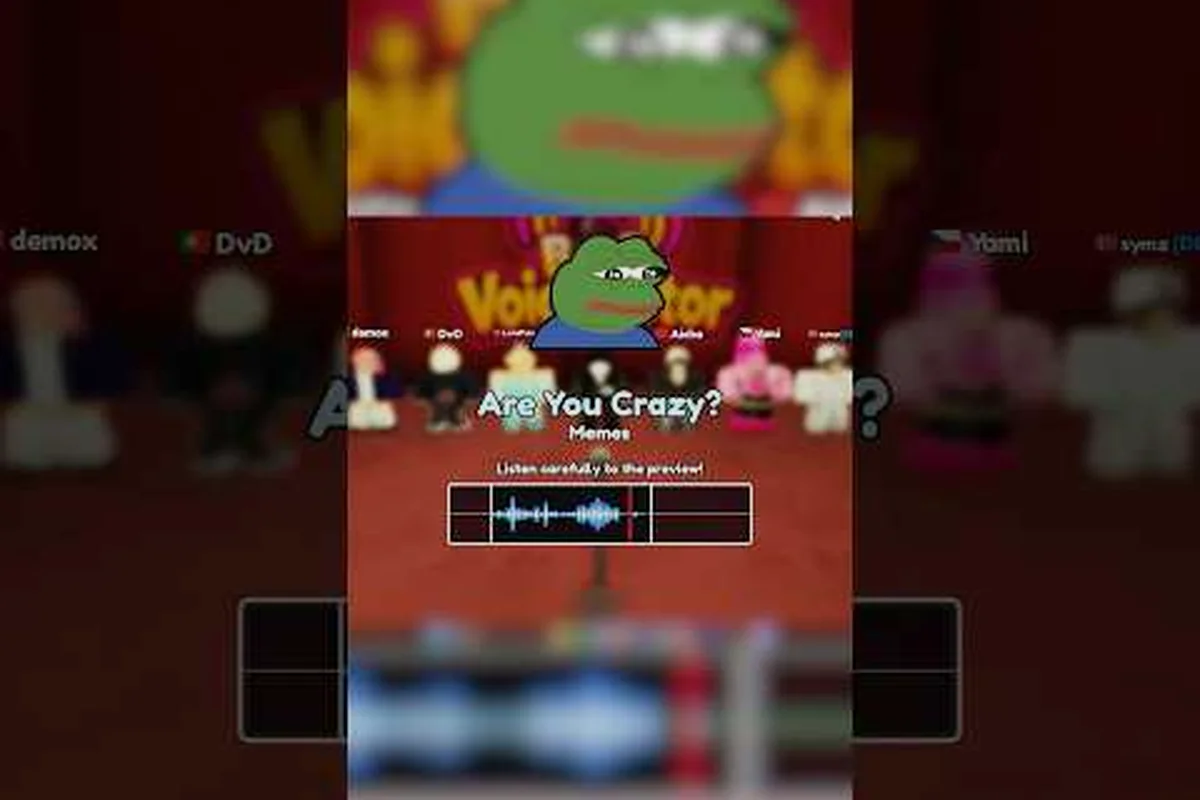
Your first session in Be A Voice Actor can feel chaotic if you queue without knowing how a round actually flows. This be a voice actor tutorial walks through the full opening loop—from verifying your microphone to reading the lobby lineup and surviving your first scoring vote—so you can step onto the red stage with a clear plan instead of guessing at the rules. The experience requires platform voice verification before you can compete, which means a quick settings check saves you from sitting in a lobby as a silent spectator.
What Be A Voice Actor Explained Means for New Players
Before you touch the queue button, it helps to understand what Be A Voice Actor actually is at the mechanical level. The official Roblox listing describes the core loop in three short phrases: compete to become the best voice actor, imitate popular sounds, and gain the highest score. That is the entire game—there is no open world, no inventory management, and no side quests. You listen to a sound clip, you reproduce it into your microphone, and the lobby votes on how convincing your performance was.
| Core loop phase | What the game does mechanically | What you do as a new player |
|---|---|---|
| Clip playback | Game plays one popular sound clip to the full 7-player lobby | Listen without speaking; the same clip is shared by every performer that round |
| Mic rotation | Each player takes one turn at the center microphone prop on the red stage | Reproduce the clip into your mic while the rest of the lobby listens |
| Voting | Lobby judges each performance after the full rotation, not after each clip | Vote on other players' imitations; your own score depends on their votes |
| Scoreboard update | Ranking appears only at the end of the session | Check your final placement after the full round rotation completes |
The stage layout matters more than most new players expect. Community gameplay recordings show a row of players lined up on a red stage with a microphone prop placed in the center. When a round starts, the game plays a clip for everyone, then each player takes a turn at the mic while the rest of the lobby listens and prepares to vote. The scoreboard appears at the end of the session, which means you will not see incremental point gains after every single clip—your ranking updates after the full rotation completes.
One important constraint shapes the entire experience: the game enforces a hard 7-player server cap. This keeps rounds short and prevents lobbies from dragging on with fifteen performers waiting for a turn. It also means queue times stay reasonable, because the matchmaker only needs to fill seven slots before a session can start. The developer group behind the experience, Be A Voice Actor by Frameworks, manages updates through the group wall rather than a separate website or patch notes page, so checking the official Roblox group is the most reliable way to see what changed between versions.
Reading the Lobby Lineup Before the First Clip
The lobby screen is your first real strategic tool, and most beginners ignore it completely. When you join a session, you see the other players who will vote on your performance. Pay attention to two things: how many players are already in the lobby, and whether anyone is using text chat to coordinate. Because the game requires voice chat to compete, players who are active in text chat before the round starts are usually experienced enough to know the flow.
Your position in the lineup also affects your strategy. If you go first, you set the baseline that every later performer gets compared against. If you go last, you hear six other interpretations of the same clip before you perform, which gives you a chance to avoid the mistakes they made. Neither position is strictly better, but understanding the tradeoff helps you decide how much risk to take on your first clip.
Verifying Voice Chat Before You Queue
The single most common reason a new player wastes their first session is skipping the voice verification step. The official game page states that Voice Chat is required to compete, which means any player who has not completed platform voice verification cannot take part in a scoring round. This is not a soft recommendation—it is a hard gate. If you queue without a verified microphone, you will sit in the lobby watching other players perform while the game refuses to give you a turn.
Roblox voice verification happens at the platform level, not inside the experience. You need to verify your age and enable voice chat in your Roblox account settings before you launch Be A Voice Actor. The process takes a few minutes and requires a government ID or other age verification method depending on your region. Once verified, you should test your microphone in a private server or a different voice-enabled experience before queueing, because a microphone that works in Discord might still be muted or misconfigured inside Roblox.
The community gameplay upload from the Enki Army match recording shows what a normal match looks like when everyone has working audio: the clip plays, each player steps up to the mic, and the scoreboard appears without any technical interruptions. Watching a full match before your first queue is the fastest way to internalize the round structure, because you see exactly when the game expects you to speak and when you should stay quiet.
Setting Up Your Audio Before the First Round
Your microphone quality directly affects your score, but not in the way most beginners assume. The game does not grade you on audio fidelity—it grades you on how convincingly you reproduce the target sound. A budget headset with clear mid-range response will often outperform an expensive studio mic if the budget mic captures your voice without clipping or background noise. The headset selection guide breaks down which audio profiles work best for the imitate-the-sound format, but the short version is that you want a mic that picks up your voice cleanly at normal speaking volume without requiring you to shout.
Background noise is a bigger problem than microphone quality. If your keyboard clicks, your fan hums, or your family is watching TV in the next room, the lobby hears all of that when you perform. Players consistently report that noisy performances score lower even when the vocal impression itself is accurate, because the extra noise makes it harder for voters to judge whether you actually matched the clip. Close your door, mute your speakers, and do a quick test recording before you queue.
How One Scoring Round Plays Out From Clip to Vote
Understanding the round structure is the core of any be a voice actor strategy, because every decision you make happens inside this loop. The flow is simple on the surface: the game plays a sound clip, every player hears the same clip, then each player takes a turn reproducing it into the microphone. After all seven players have performed, the lobby votes on who matched the clip most convincingly, and the scoreboard updates.
The clip itself is the variable that changes everything. Some clips are short vocalizations—a laugh, a scream, a specific phrase—while others are non-vocal sounds like an engine revving or a cartoon noise. Your approach should shift depending on the clip type. Vocal clips reward accuracy of tone and pacing, while non-vocal clips reward creativity and commitment. A player who hesitates on a non-vocal clip almost always scores lower than one who commits fully, even if the committed performance is technically less accurate.
Here is a breakdown of the round flow with estimated timing based on community reports:
| Round Phase | What Happens | Player Action | Timing Estimate |
|---|---|---|---|
| Clip Playback | Game plays the target sound for all players | Listen carefully, note pitch and rhythm | 5-10 seconds |
| Performance Rotation | Each player takes a turn at the mic | Reproduce the clip when it is your turn | 10-20 seconds per player |
| Voting Window | Lobby votes on the best performance | Cast your vote for the most convincing player | 10-15 seconds |
| Scoreboard Update | Rankings refresh after the full rotation | Review your position and adjust strategy | 5-10 seconds |
What the Voting Window Actually Rewards
The voting system is the least understood part of Be A Voice Actor, and it is where most new players lose points without realizing why. Voters are not judging you against the original clip in a vacuum—they are judging you against the other six performances they just heard. This means your score is relative, not absolute. A mediocre performance can win a round if everyone else performed worse, and a strong performance can lose if someone else nailed the clip perfectly.
Because voting happens after all seven players have performed, recency bias plays a real role. The last few performers are fresher in voters' minds when the voting window opens. This does not mean you should always try to go last, but it does mean you should make your performance memorable if you are in the middle of the rotation. A distinctive choice—an unexpected pitch shift, a committed physical performance that comes through in your voice, or a perfectly timed pause—sticks in voters' minds longer than a technically accurate but forgettable reproduction.
Be A Voice Actor Etiquette That Keeps Lobbies Healthy
The social layer of Be A Voice Actor matters as much as the mechanical layer, because you are performing for six other real people who will vote on you. Be A Voice Actor etiquette is not written down anywhere in the game, but experienced players consistently follow a few unwritten rules that keep lobbies fun and fair. Breaking these rules does not get you banned, but it does get you voted down consistently, because voters punish behavior that makes the session less enjoyable for everyone.
The first rule is simple: stay quiet when it is not your turn. Background chatter during another player's performance makes it impossible for voters to hear the clip reproduction clearly, and it signals that you do not respect the other players' time. The second rule is to commit fully to every clip, even the ones you think are silly. A player who half-heartedly mumbles through a clip because they are embarrassed drags down the energy of the entire lobby, and voters remember that when the voting window opens.
The third rule is about voting honestly. Some players try to vote strategically—voting against the strongest performer to boost their own relative position—but this backfires in the long run. The game's scoring system rewards consistent performance over time, and lobbies that vote honestly produce more accurate scoreboards. If you want to understand how the scoring math works under the hood, the score farming guide explains why honest voting benefits everyone in the lobby, including you.
Common Etiquette Mistakes That Cost You Votes
New players make the same etiquette mistakes over and over, and each one costs points. The most common mistake is talking over the clip playback. When the game plays the target sound, everyone needs to hear it clearly. If you are chatting or laughing during playback, you miss details that would have improved your own performance, and you annoy the players who were trying to listen.
The second mistake is complaining about your score after the voting window closes. Every player has been voted lower than they expected at some point, and the lobby does not want to hear a post-round rant. A better use of that energy is to watch what the winning player did differently and adjust your approach for the next clip. The third mistake is quitting mid-session. Because the game runs on a 7-player rotation, one player leaving forces the lobby to either continue with six or wait for a replacement, which disrupts the flow for everyone.
Building a Simple Be A Voice Actor Strategy for Your First Five Rounds
Your first session should have a clear plan, not just a vague intention to "do your best." A simple be a voice actor strategy for beginners focuses on three things: listening more carefully than you think you need to, committing fully to every clip, and treating your first five rounds as data collection rather than a competition. The players who improve fastest are the ones who treat early losses as information about what voters reward.
Start with a listening-first approach. Before you perform, spend the clip playback window actively analyzing the sound: what is the pitch, what is the rhythm, where does the emphasis fall, and what makes this clip distinctive. Most beginners spend the playback window thinking about what they are going to do, which means they miss half the details. Write the clip in your head as a sequence of sounds, not as a single impression.
Then commit to a full-commitment performance. The biggest scoring difference between beginners and experienced players is not vocal talent—it is willingness to sound silly. A player who fully commits to a cartoon noise or an exaggerated accent scores higher than one who holds back, even if the held-back performance is technically more accurate. Voters reward confidence because confidence reads as intentionality, and intentionality is what makes a performance convincing.
Tracking Your Early Results Without Obsessing
Your first five rounds are a calibration period. Pay attention to which clip types you score well on and which ones drag your ranking down. Some players are naturally strong at vocal impressions but weak at non-vocal sounds, while others have the opposite profile. Knowing your strengths helps you decide where to take risks and where to play it safe.
Here is a simple tracking framework for your opening session:
| Clip Type | Your Approach | Typical Result | Adjustment for Next Round |
|---|---|---|---|
| Short vocal phrase | Match pitch and pacing exactly | Strong if you listened carefully | Push for more emotional range |
| Non-vocal sound | Commit fully, exaggerate slightly | Variable depending on creativity | Try a completely different angle |
| Long vocal clip | Focus on rhythm and breath control | Weaker if you run out of air | Take a deeper breath before starting |
| Accent or character voice | Lean into the stereotype | Strong if you commit fully | Add a physical gesture to sell it |
The winning strategy guide goes deeper into consistency tactics and voting psychology, but for your opening session the key is to gather data without getting discouraged by early losses. Every player starts at the bottom of the scoreboard, and the ones who climb are the ones who treat each round as a learning opportunity.
What the Scoreboard Tells You After Your First Session
The scoreboard at the end of your first session is more informative than most new players realize. It does not just show you who won—it shows you the gap between your performance and the lobby average, which tells you how much room you have to improve. If you finished last but the gap was small, your fundamentals are solid and you just need more reps. If you finished last by a wide margin, you need to rethink your approach to clip analysis or performance commitment.
The scoreboard also reveals which players in the lobby are consistently strong, and watching their performances across multiple rounds is the fastest free education you can get. Pay attention to what they do differently: how they handle the playback window, how they position themselves at the mic, and how they use their voice to sell the clip. You do not need to copy them exactly, but understanding why they score well gives you a template to adapt to your own strengths.
Your progression through the title system is tracked separately from your round-by-round score, and the max level guide explains how your profile stats accumulate over time. For now, focus on the immediate feedback loop: each round gives you a clip, a performance, and a vote, and the faster you close that loop with honest self-assessment, the faster you improve.
Frequently Asked Questions
Do I need to verify my voice chat before playing Be A Voice Actor?
Yes, voice verification is mandatory. The official game page states that Voice Chat is required to compete, so unverified players cannot participate in scoring rounds. Complete Roblox platform verification in your account settings before queueing, then test your microphone in another voice-enabled experience to confirm everything works.
How many players are in a Be A Voice Actor lobby?
The game enforces a hard 7-player server cap, which keeps rounds short and prevents long wait times between performances. Each player gets one turn at the microphone per round, and the voting window opens after all seven players have performed. Smaller lobbies are possible if someone leaves mid-session.
What happens if my microphone stops working mid-round?
You will not be able to perform when your turn arrives, and the lobby will either skip you or wait while you troubleshoot. The best prevention is testing your audio before queueing and closing any background applications that might interfere with your microphone. If your mic fails mid-session, leave the lobby rather than forcing six other players to wait.
Is Be A Voice Actor free to play?
The core experience is free to access, but the official listing mentions Special Gamepasses With Exclusive Perks that are available for purchase. These gamepasses are optional and do not gate the core imitate-the-sound loop. You can compete and climb the scoreboard without spending anything.
How long does one full session take?
A full session with seven players typically runs between five and ten minutes, depending on how many rounds the lobby plays and how quickly players vote. The 7-player cap keeps rotations tight, so you can usually complete several rounds in a single sitting without a major time commitment.